Build a changelog page for your product
You can build a changelog page without writing code: describe your product and how you announce updates, and Fabricate builds a working page of dated release notes with tags such as New, Improved and Fixed, screenshots, a search and a filter, and a page only you can sign in to, where you write and publish each update without going back to the chat.
Link to it from your product, your docs and your own emails. Try it with a test update first, then ask for changes in the same chat.
- Free plan: 60 credits a month
- No card needed
- Live link included
From one message to a changelog page
Then try it yourself and ask for changes in the same chat until it fits.
You write: A changelog page for my scheduling app. Each update has a date, a title, a short summary, the details and screenshots, with tags for New, Improved and Fixed and a filter by tag. Readers search every update. Only I can sign in, to write updates, save drafts and publish them. Make it easy to use on a phone.
 Fabricate
I built your changelog page: dated updates with a title, a summary, the details and screenshots, New, Improved and Fixed tags with a filter, a search, and an editor only you can sign in to, with drafts. Post a test update in the preview.
Then ask for changes, such as
- Add a sign-up form for updates
- Add a roadmap
- Use our product colours
A whole new app usually takes about 20 to 35 credits.
Fabricate CloudFabricate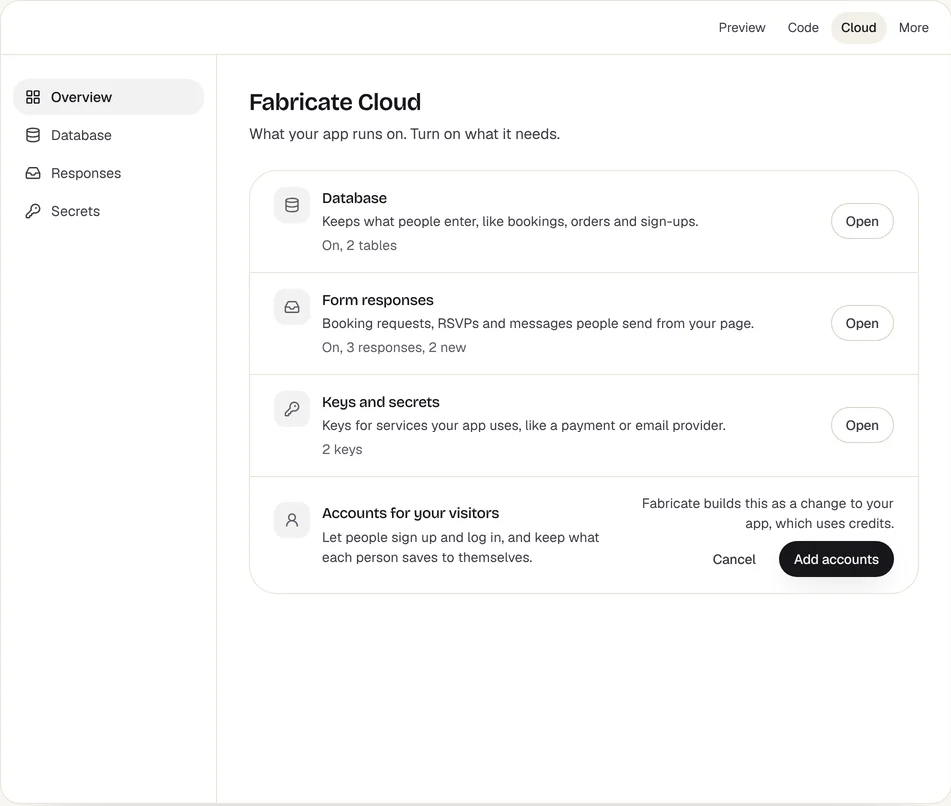
Who builds a changelog page
SaaS and app makers
Show users what changed, and that the product is moving.
Developer tools and APIs
Versioned release notes with breaking changes marked.
Open-source projects
Releases and what each one means, in plain words.
Product and support teams
One place to point customers when they ask what is new.
What your changelog page comes with
Dated updates
Each update with its date, a title, a summary and the details.
Tags and a filter
New, Improved and Fixed, or tags of your own, with a filter.
Screenshots
Images in each update, uploaded from your editor.
Search
Readers search every update by word.
An editor for you
A page only you sign in to, where you write, save drafts and publish updates.
Sign-up for updates
A form where readers leave their email, with the addresses under Responses.
In short
- A changelog page with dated release notes, tags, screenshots and search can be built from a plain-English description
- You write and publish each update from your own editor without going back to the chat
- Update emails, embedded widgets and imports from GitHub are not built in
What goes into a changelog page built with Fabricate
A changelog shows users that the product is moving, and tells them what changed before they ask support. Changelog tools work, but they come with their own widget, their own look and a price per seat. A changelog page built with Fabricate starts from your description of your product and the way you announce updates.
Reading: dated updates with a title, a summary and the details, tags such as New, Improved and Fixed with a filter, screenshots, and a search across every update. Ask for versions with breaking changes marked, a page for each update with its own link, or reactions on each update.
Writing: a page only you can sign in to, where you write each update, save it as a draft and publish it when the release ships. Ask for a sign-up form; once the page is published, the addresses arrive under Responses in Fabricate.
What is not built in: sending update emails, a widget that sits inside another app, and reading releases or commits from GitHub. Link to the page from your product, your docs and your own emails.
Changelog pages you can start from
Choose one and the builder opens with its description filled in. Change any word before you build.
How to build a changelog page
Four steps, all in one chat.
- 1Describe your product
What you ship and how you announce it.
- 2Post a test update
Publish an update from your editor, then filter by its tag.
- 3Ask for changes
Add a page, a field or a colour by asking in the same chat.
- 4Publish it
The live app starts with a fresh database, so your test entries stay behind.
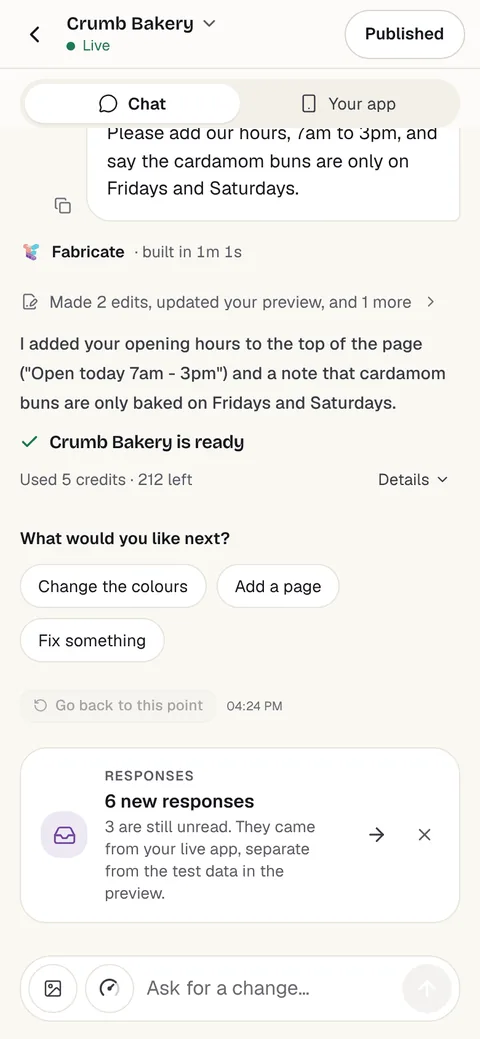
Chat
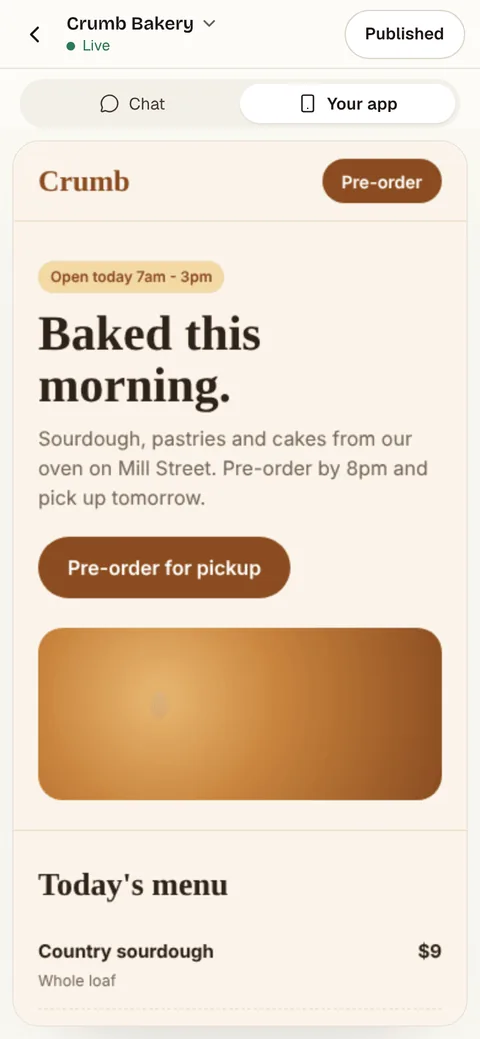
Your app
- Free60 credits a monthBuild, preview and publish. No card needed.
- A new app20 to 35 creditsA small change is about 3 to 10 credits.
- Pro350 credits a monthA live link and your own domain. Prices are on the pricing page.
Questions about changelog pages
- Can I build a changelog page without coding?
- Yes. Describe your product and how you announce updates, and Fabricate builds the changelog page and shows it working in a preview. To change something, you ask in the chat. There is no code to write or read.
- Can I post updates without the chat?
- Yes, if you ask for it: a page only you can sign in to, where you write each update with a date, a title, tags and screenshots, save it as a draft and publish it. Changes to the design are made by asking in the chat.
- Can users get an email when I post an update?
- Readers can leave their email with a sign-up form, and once the page is published the addresses arrive under Responses in Fabricate, with a download as a CSV file. Sending update emails is not built in, so send them from your own email tool.
- Can I show it inside my product?
- A widget that sits inside another app is not built in, so link to the page from your product, for example from a "What is new" item in its menu.
- Can it pull release notes from GitHub?
- No. It does not read releases or commits from GitHub. You write each update in your editor, which also lets you say what changed in your users' words.
- Will it show up on Google?
- Publishing puts it on the web, where search engines and AI assistants look. Under More > SEO & AI search you can see what they read on your live site and change its title and description. Nobody can promise a place in search results.
- What does it cost?
- You can start on Free, which includes 60 credits a month and needs no card. A whole new app usually takes about 20 to 35 credits and a small change about 3 to 10 credits. Current plans are on the pricing page.
Keep reading
Every Build page- Build a Documentation SiteDocs with a sidebar, search and a page for every topic.Build it
- Build a BlogPosts, categories and a writing page only you can open.Build it
- Build a SaaS DashboardUsers, plans and the numbers that matter for your product.Build it
- Build an AI Startup WebsiteA launch page, a working demo and a waitlist.Build it
- Build an MVPA working first version of your product for your first users.Build it
- Build a Waitlist PageA launch page that collects sign-ups before you open.Build it
Start your changelog page
Describe your product and your updates. Post a test update, then share the link.
Build free. No card needed.
Related pages
Build a directory website
Describe your listings and Fabricate builds a directory website: categories, search, listing pages and listing requests....
Read moreBuild an online course platform
Describe your course and Fabricate builds an online course platform: student sign-in, lessons, quizzes and progress trac...
Read moreBuild an online community platform
Describe your members and Fabricate builds an online community: member sign-in, forums, profiles, events and moderation....
Read moreBuild a hotel website with booking requests
Describe your rooms and Fabricate builds a hotel website: rooms, prices, photos and a booking request form for each stay...
Read moreEverything You Can Build
Explore use cases, from MVPs to marketplaces.
Read moreAI App Builder
Describe your app and get a frontend, database, logins and a live URL in minutes.
Read more