AlternativesUpdated
Claude alternatives for building a real app
Claude builds an artifact on a Claude link. For an app with its own address, customer accounts and payments, these are the alternatives.
 Client portal
Key takeaways
- Claude is a general assistant. What it builds for you is an artifact: a page, dashboard or small tool that opens from a link.
- An artifact can save up to 100 MB of data on paid plans and can call Claude, with each visitor signing in to Claude for those parts. Claude's help pages name no custom domain, customer accounts or checkout.
- Fabricate builds and hosts the whole app from a description: screens, server code, a database and sign-in for your own users. Building and publishing start free.
- You do not have to leave Claude. Fabricate can be added to it as a connector, and Claude Code comes with Claude Pro for people who code.
Why people look past Claude to build an app
Claude can write the code for almost anything. What it hands back is an artifact, and each reason below is a point where an artifact and an app part ways.
A link, not an address of your own
A published artifact opens from a link Claude gives you, and can be embedded on sites you list. Claude's help pages name no way to put it on your own domain.
Fits: FabricateSign-in belongs to Claude
Anyone can open a published artifact, but the parts that use Claude ask each visitor to sign in to Claude, and that use counts against their own plan. An app for customers needs accounts you hold.
Fits: FabricateNothing takes a payment
An artifact can save data, up to 100 MB and 25,000 records on a paid plan. Claude's help pages describe no checkout, so charging a customer means an app with one.
Fits: FabricateYou code, and want real files
If you would rather have the code in a repository than a tool beside a chat, Claude's own coding agent works in your codebase and comes with the Pro plan.
Fits: Claude Code
Compare at a glance
Fabricate beside Claude, feature by feature.
- What you get back
- Fabricate
- A hosted app, with its own code
- Claude
- An artifact beside a chat
- Where it lives
- Fabricate
- Its own address
- Claude
- A link from Claude, or embedded on sites you allow
- Your own domain
- Fabricate
- On Pro and Max
- Claude
- Not named in Claude's help pages
- Sign-in for your users
- Fabricate
- Accounts the app holds
- Claude
- A Claude account, for the parts that use Claude
- Saved data
- Fabricate
- A database in the app's own code
- Claude
- Up to 100 MB and 25,000 records, on paid plans
- Taking payments
- Fabricate
- Stripe Checkout on Pro and Max
- Claude
- Not named in Claude's help pages
- Writing, research and analysis
- Fabricate
- Not what it is for
- Claude
- What Claude is for
- Paid plans from
- Fabricate
- $25 a month
- Claude
- $20 a month
Fabricate
We make thisBest for: A finished app, online, with no developer
Claude helps you make it; Fabricate hands you the finished app. Describe it in a sentence and Fabricate writes the screens, the server code, a database and sign-in for your own users, opens the app in a real browser to check it, and hosts it at its own address. You can also add Fabricate to Claude as a connector and ask for the build from the chat you already use. Building and publishing start free.
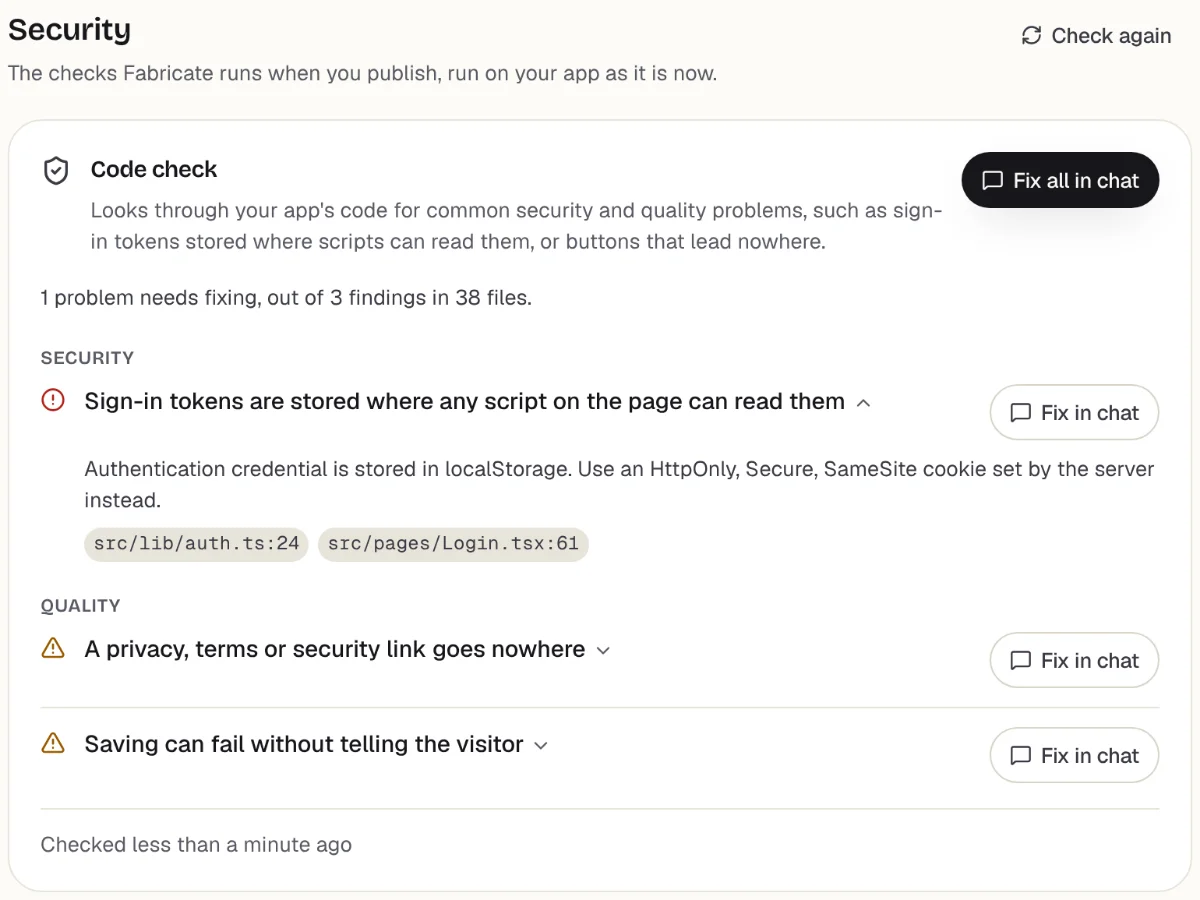
Checks before you publish
What it does well
- Accounts for your own users
- A database in the app's own code
- Stripe Checkout on Pro and Max
- Works from inside Claude, as a connector
- Paid plans from
- $25 a month
- 350 credits a month on Pro
- Free plan
- 60 credits
- A month, to build and publish
- A live app
- Every plan
- Publishing is on every plan
The other Claude alternatives
What each one does well, and the kind of project it suits best.
- Number 2
ChatGPT
Best for: Staying inside a chat assistant
The other general assistant, and one that now hosts what it builds. Sites, in ChatGPT and Codex, builds and hosts a website or web app with a database, and its hosting allowance comes with Plus at $20 a month. The sign-in it provides is Sign in with ChatGPT, and from January 1, 2027 use above the allowance is paid for in credits.
- Builds and hosts a site from the chat
- A database, and sign-in with ChatGPT
- Your own domain, where available
When to pick ChatGPT
If you want one assistant for everyday work that also puts a site online, ChatGPT does both, where what Claude builds stays an artifact on a link.
From $20 a monthChatGPT alternativesSources: ChatGPT docs: pricing (opens in a new tab), checked ; ChatGPT docs: Sites (opens in a new tab), checked ; ChatGPT docs: a site's data and connections (opens in a new tab), checked ; ChatGPT docs: managing a site (opens in a new tab), checked
- Number 3
Lovable
Best for: A web app a team builds together
Lovable builds a web app from a conversation, runs its database, sign-in and storage on Lovable Cloud, and keeps the code in a GitHub repository. Where an artifact is one tool beside a chat, a Lovable project is a whole app you keep changing. Pro is $25 a month for any number of users, and on the free plan an app goes online at a lovable.app address, with the Lovable badge.
- A whole app, not one tool
- Backend on Lovable Cloud
- Code kept on GitHub
When to pick Lovable
If several of you will build it and you want the code in GitHub from the first day, one Lovable Pro plan covers the whole team.
From $25 a monthLovable alternativesSources: lovable.dev/pricing (opens in a new tab), checked ; Lovable docs: who can visit your published app (opens in a new tab), checked ; Lovable docs: Lovable Cloud (opens in a new tab), checked ; Lovable docs: GitHub (opens in a new tab), checked
- Number 4
Bolt.new
Best for: A first version online before you pay
Bolt.new builds a full-stack app in the browser on Bolt Cloud, with a database, sign-in, storage and server functions, and hosts it. On its free plan a site goes online with Bolt branding and a monthly cap on requests, and Pro is $25 a month.
- Hosting on its free plan, with Bolt branding
- Database and sign-in on Bolt Cloud
- Code you can download
When to pick Bolt.new
If you want to see the app running at a public address before paying anything, Bolt hosts it on its free plan, with its branding on the site.
From $25 a monthBolt.new alternativesSources: bolt.new/pricing (opens in a new tab), checked ; Bolt help: Bolt Cloud (opens in a new tab), checked ; Bolt help: project files (opens in a new tab), checked
- Number 5
Replit
Best for: Seeing and editing the code yourself
Replit's Agent builds the app in a browser workspace where the code, a terminal and the database sit beside it, and publishes it from there. It suits you if Claude's code made you curious enough to open the files. Core is $20 a month, with credits that pay for the Agent and for running the app.
- Code, terminal and database in one workspace
- Publishing built in
- An Agent you can watch work
When to pick Replit
If you want to watch the app being written and step in by hand, Replit shows every file, where Claude shows you the result.
From $20 a monthReplit alternativesSources: replit.com/pricing (opens in a new tab), checked ; Replit docs: Replit Core (opens in a new tab), checked
- Number 6
Claude Code
Best for: People who can run a codebase
Anthropic's own answer for people who code. Claude Code reads a codebase, edits files, runs commands and opens pull requests, in a terminal, an editor, a desktop app or the browser, and it comes with Claude Pro at $20 a month. It writes the app's code; where the app runs is yours to arrange.
- On the Claude plan you may already pay for
- Works in your own repository
- Terminal, editor, desktop app or browser
When to pick Claude Code
If you are comfortable with git and a host of your own, Claude Code turns the same Claude into real files in a real project, on the plan you already have.
From $20 a monthClaude Code alternativesSources: Claude Code docs: overview (opens in a new tab), checked ; claude.com/product/claude-code (opens in a new tab), checked ; claude.com/pricing (opens in a new tab), checked
From an artifact to an app people use
Most people reach this page the same way. They asked Claude for a tool, had a working artifact in a minute and shared the link. Then someone asked to log in, or to pay, or for a proper web address. None of that is a flaw in Claude: an artifact is made to sit beside a conversation.
An app that other people rely on needs four things an artifact does not set out to give: an address of its own, accounts that belong to you, a database that grows with the business, and somewhere to run. You can assemble those yourself around the code Claude writes, with a host, a database service and a sign-in service, and Claude Code makes that quicker if you know your way around a repository.
Or you can have them built together. Fabricate takes the same plain description you would give Claude and returns the app with those parts in place, checked in a real browser and hosted. Credits pay for AI work, building the app and, on Pro and Max, the AI inside it; serving the published app is part of the plan.
Claude still earns its place. Use it to think the app through, to write the description, and for the writing and analysis around your business. Claude Cowork goes further and finishes whole tasks for you, such as a weekly deck or a checked spreadsheet. That is work done for you, where an app is something your customers or staff use themselves.
Start with the app an artifact cannot be
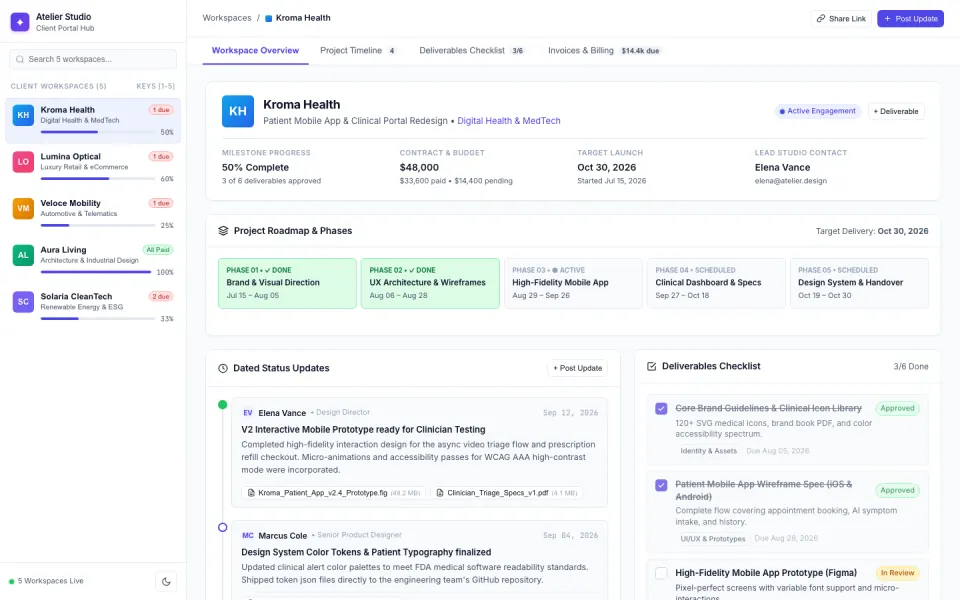
A client portal needs an account for each client and data that stays put between visits. This opens Fabricate with the build written out; change any word before you build.
Build free. No card needed.
Frequently asked questions
- Can Claude build an app?
- Claude can write an app's code and run a small one as an artifact: a page, dashboard or tool that opens from a link, saves up to 100 MB of data on paid plans and can call Claude. What an artifact lacks, going by Claude's own help pages, is your own domain, accounts for your own users and a checkout. For those the code has to be hosted somewhere, which is what an app builder does for you.
- What is the best Claude alternative for building an app?
- It depends on how much of the work you want to do. Fabricate, which we make, builds and hosts the whole app from a description. Lovable and Bolt.new do the same on their own backends, Replit suits people who want to see the code, and Claude Code is for people who can run a codebase. ChatGPT is the nearest like-for-like assistant, and it now hosts sites.
- Is there a free Claude alternative for making an app?
- Claude's own free plan makes artifacts. Among the builders, Fabricate's Free plan gives 60 credits a month with no card. Building and publishing start free. On Bolt.new's free plan a site goes online with Bolt branding, and on Lovable's at a lovable.app address with the Lovable badge.
- Can I keep using Claude and still get a real app?
- Yes, in two ways. Plan the app with Claude, then paste the description into Fabricate. Or add Fabricate to Claude as a custom connector: Claude sends your description to Fabricate, shows how the build is going and opens a preview. Nothing is published until you approve it in Fabricate, and builds use your Fabricate credits.
- Does Fabricate use Claude?
- Fabricate builds with Claude models. What it adds is everything around the code: the database, sign-in, hosting, and a check in a real browser that stops a broken app from being published. It does not replace Claude for writing, research or analysis.
- What about Claude Cowork and Claude Design?
- Cowork takes a task and comes back with finished work, such as a deck, a spreadsheet or a memo, on a schedule if you like. Claude Design turns a description into a visual you can share or download. Design is on every Claude plan and Cowork on the paid ones, and neither is described as hosting an app for your customers.
Sources
The pages this guide quotes, each with the day it was read.
- claude.com/pricing (opens in a new tab), checked
- Claude help: what artifacts are (opens in a new tab), checked
- Claude help: sharing artifacts (opens in a new tab), checked
- claude.com/product/cowork (opens in a new tab), checked
- claude.com/product/design (opens in a new tab), checked
- ChatGPT docs: pricing (opens in a new tab), checked
- ChatGPT docs: Sites (opens in a new tab), checked
- ChatGPT docs: a site's data and connections (opens in a new tab), checked
- ChatGPT docs: managing a site (opens in a new tab), checked
- lovable.dev/pricing (opens in a new tab), checked
- Lovable docs: who can visit your published app (opens in a new tab), checked
- Lovable docs: Lovable Cloud (opens in a new tab), checked
- Lovable docs: GitHub (opens in a new tab), checked
- bolt.new/pricing (opens in a new tab), checked
- Bolt help: Bolt Cloud (opens in a new tab), checked
- Bolt help: project files (opens in a new tab), checked
- replit.com/pricing (opens in a new tab), checked
- Replit docs: Replit Core (opens in a new tab), checked
- Claude Code docs: overview (opens in a new tab), checked
- claude.com/product/claude-code (opens in a new tab), checked
- fabricate.build/pricing, from our live plans
About this guide
Written by the Fabricate team. Fabricate is our product, so it is first on this page and marked "We make this". Where a reason to switch fits another tool better, the reason says which.
Each tool's card lists the pages we read about it and the day we read them. We compared the tools from their own pricing pages and documentation, not by signing up for them. Spotted something out of date? Write to info@fabricate.build.
Related guides
All alternatives- Claude Artifacts AlternativesThe same question for one artifact: what to use when it has to become a real app.Alternatives
- Claude Code AlternativesFor people who code: other agents, and builders that host the result.Alternatives
- Claude Design AlternativesWhen a mockup has to take bookings, sign people in and save what they enter.Alternatives
- ChatGPT AlternativesThe same guide for ChatGPT, which now hosts sites of its own.Alternatives
- Build from ChatGPT or ClaudeAdd Fabricate to your assistant and ask for the app from the chat.Feature
- Build a Client PortalWhat a client portal built with Fabricate includes, and a prompt to start from.Build it
Related pages
ChatGPT Alternatives
ChatGPT now hosts sites, with Sign in with ChatGPT built in. Compare six alternatives for an app with accounts of its ow...
Read moreClaude Design Alternatives
Claude Design makes mockups and clickable flows. Compare six alternatives that turn the design into a working app with s...
Read moreAll AI App Builder Alternatives
Compare every alternative we have reviewed, side by side.
Read moreAI App Builder
Describe your app and get a frontend, database, logins and a live URL in minutes.
Read more