AlternativesUpdated
Best Softgen Alternatives in 2026
Softgen writes full-stack Next.js apps into a GitHub repository you own, with Supabase for data and sign-in, Stripe for payments and Resend for email, and deploys them to Vercel. Starter is $25 a month and Pro $49. Here is how six alternatives compare for someone leaving it.
The Rebuild my site box from Fabricate's home page. It opens Fabricate with your rebuild written out, and nothing is built until you press Build there.
Key takeaways
- Softgen writes standard Next.js into a GitHub repository you own, with Supabase, Stripe and Resend, and deploys it to Vercel.
- Softgen's Starter is $25 a month for 500 credits and 10 projects; Pro, at $49 for 1,500 credits, adds unlimited projects, custom domains and Supabase backups.
- Fabricate writes the backend into the app and serves it as its own Cloudflare Worker, with no Supabase project or Vercel account. Building and publishing start free.
- Fabricate's Import a project page takes a Next.js project from GitHub or a .zip, and its first build gets the project running.
Why Consider Softgen Alternatives?
Softgen's code is standard Next.js in a repository you own, so the reasons to look elsewhere are about its plans and the services an app runs on. Some name the alternative that fits them.
Publishing Starts on Starter
Softgen starts with free trial credits and no card; GitHub, publishing and the full choice of models come with Starter, at $25 a month for 500 credits and 10 projects.
Your Own Domain on Pro
A custom domain, unlimited projects, Supabase backups and a month of credit rollover come with Pro, at $49 a month for 1,500 credits.
An App Spread Across Services
A Softgen app runs on Supabase and Vercel, with Stripe and Resend beside them. Some builders write the backend into the app's own code and serve the app themselves.
Fits: FabricateNext.js a Developer Can Pick Up
Because a Softgen project is ordinary Next.js in your GitHub repository, a developer can carry on in an AI code editor on the same code.
Fits: Cursor
Compare at a glance
Fabricate beside Softgen, feature by feature.
- Builds the Backend Too
- Fabricate
- Yes
- Softgen
- Yes
- Where the Backend Runs
- Fabricate
- Inside the app, with its own SQLite database
- Softgen
- Supabase, managed by Softgen or your own
- Where the App Is Served
- Fabricate
- By Fabricate, on every plan
- Softgen
- Vercel, on your account or through Softgen
- Payments
- Fabricate
- Stripe Checkout, on Pro and Max
- Softgen
- Stripe
- Your Own Domain
- Fabricate
- Up to 5 on Pro, 20 on Max
- Softgen
- On Pro, at $49 a month
- Code You Keep
- Fabricate
- Downloaded or sent to GitHub, on Pro and Max
- Softgen
- A GitHub repository you own, from Starter
- Plans Start At
- Fabricate
- Pro at $25 a month
- Softgen
- Starter at $25 a month, 500 credits
Fabricate
We make thisBest for: A full-stack app with nothing else to run
Where a Softgen app runs on Supabase and Vercel, managed by Softgen or on your own accounts, Fabricate writes the database, sign-in and server routes into the app's own code and serves each app as its own Cloudflare Worker, after opening it in a real browser. It can also import the Next.js project you have, which keeps using its Supabase project. Building and publishing start free.
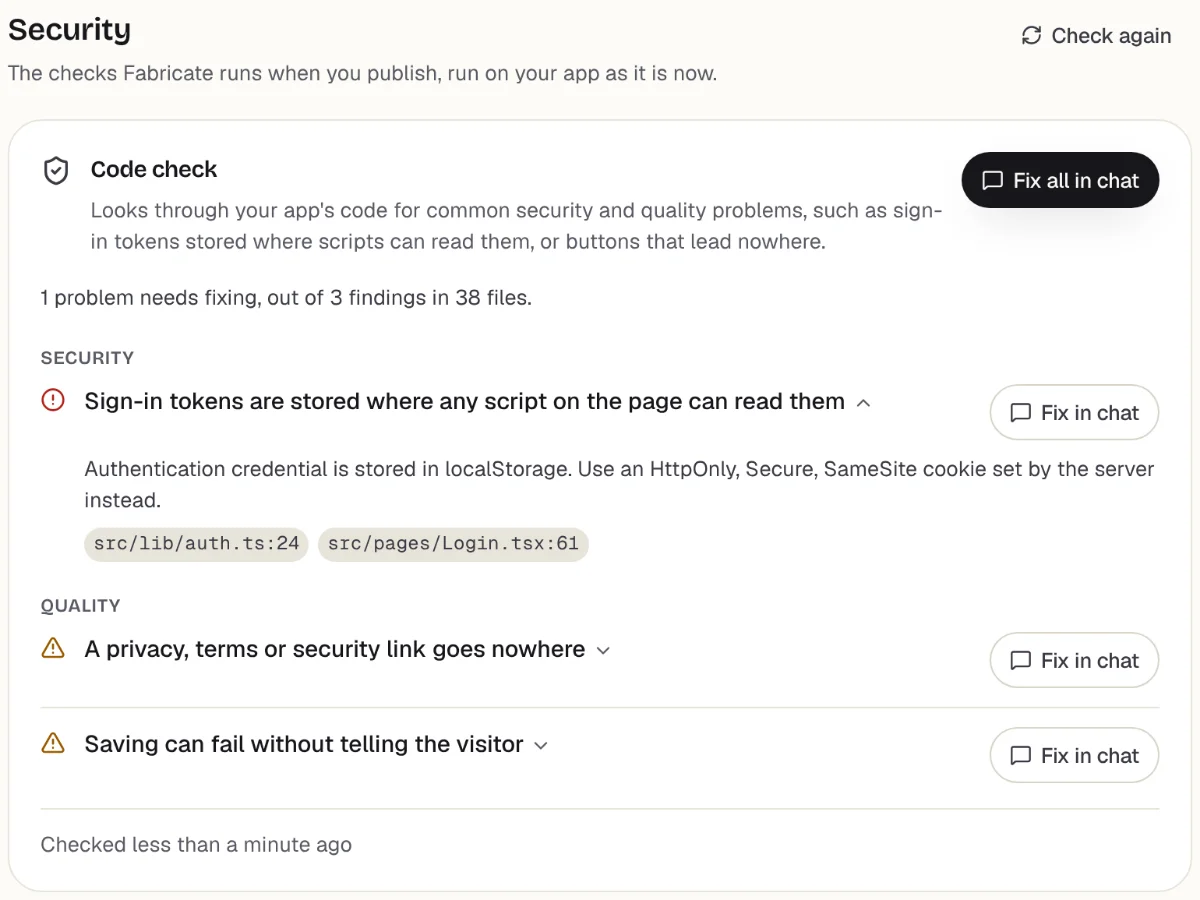
 Checks before you publish
What it does well
- The backend inside the app, not in Supabase
- Served by Fabricate, with no Vercel account
- Imports a Next.js project
- Stripe Checkout on Pro and Max
- Paid plans from
- $25 a month
- 350 credits a month on Pro
- Free plan
- 60 credits
- A month, to build and publish
- A live app
- Every plan
- Publishing is on every plan
How to Move a Softgen App to Fabricate
- 1
Get the code from GitHub
Open the repository Softgen keeps for the project. If it is private, download it as a .zip.
- 2
Import the repository
Paste the repository's address, or upload the .zip, on Fabricate's Import a project page. The check is free and shows what it found, Supabase included.
- 3
Let the first build run it
The first build uses credits to get the pages and design running as they are. Add back the secret keys it lists by name.
- 4
Or rebuild it from a description
To have the backend in the app's own code instead of Supabase, describe the app, then ask for an import page that adds your Supabase tables, saved as CSV files, to the app's own database.
- 5
Publish and point your domain
Press Publish; after the browser check the app is live, and on Pro and Max you can move your own domain across from Vercel.
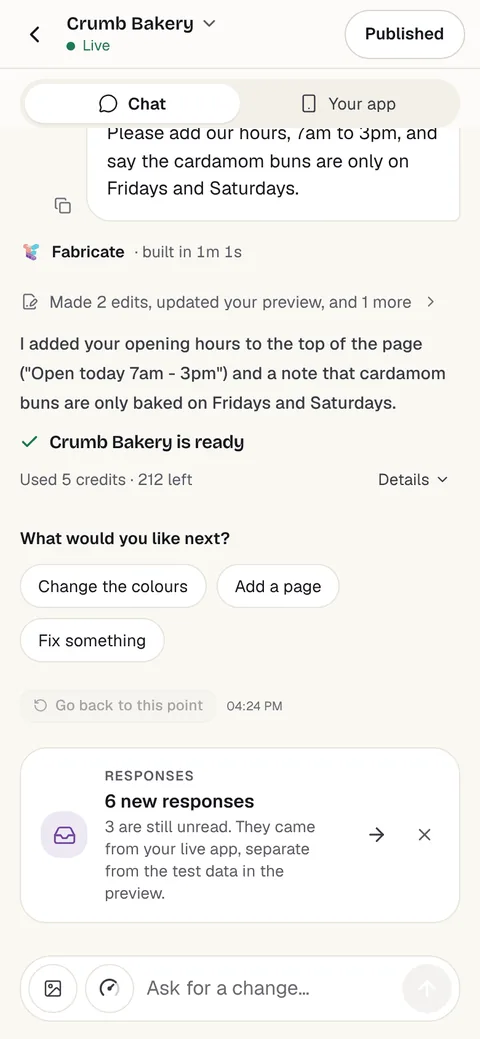
Chat
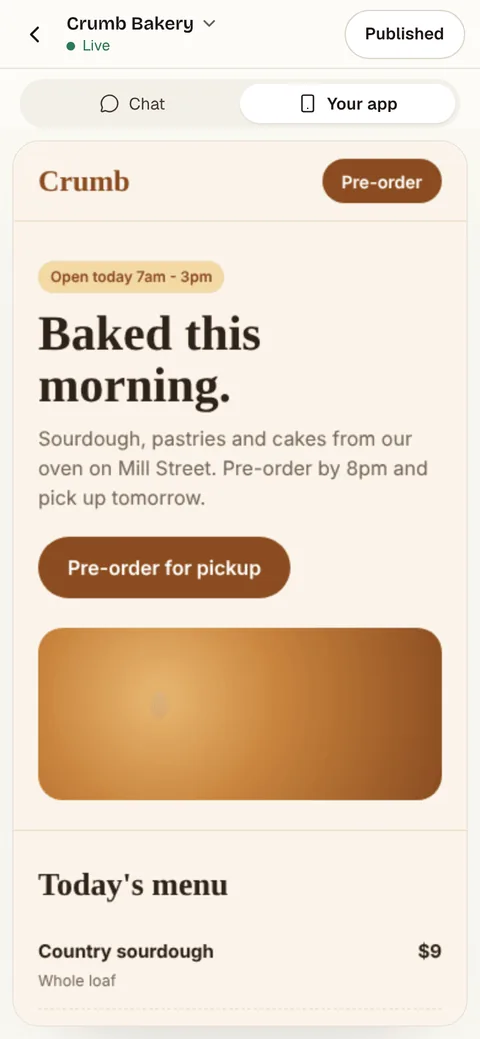
Your app
The other Softgen alternatives
What each one does well, and the kind of project it suits best.
- Number 2
Bolt.new
Best for: App and backend under one account
Bolt.new also builds full-stack apps from a prompt, but keeps the backend on Bolt Cloud instead of Supabase and Vercel: a database, sign-in, storage, server functions and Stripe, hosted by Bolt at a bolt.host address. The code can be downloaded or synced with GitHub.
- Bolt Cloud in place of Supabase
- Hosted by Bolt, at a bolt.host address
- Downloads or GitHub sync for the code
When to pick Bolt.new
If you would rather have the database, sign-in and hosting under one account than across Supabase and Vercel, Bolt Cloud keeps them together, and Expo takes the app to the App Store and Play Store.
From $25 a monthSources: bolt.new/pricing (opens in a new tab), checked ; Bolt help: Bolt Cloud (opens in a new tab), checked ; Bolt help: Expo for mobile apps (opens in a new tab), checked ; Bolt help: GitHub (opens in a new tab), checked
- Number 3
Lovable
Best for: Design-led apps with the code on GitHub
Lovable builds web apps from a conversation or a Figma design on Lovable Cloud, its own backend with a database, storage, sign-in and functions, and it can connect to a Supabase project instead. The code syncs both ways with GitHub on every plan, much as a Softgen project lives in a repository.
- Syncs with GitHub both ways, any plan
- Lovable Cloud, or Supabase if you prefer
- Builds from Figma designs too
When to pick Lovable
If you want the code on GitHub but the backend and hosting run for you, Lovable syncs both ways with GitHub on every plan and publishes to a lovable.app address.
From $25 a monthSources: lovable.dev/pricing (opens in a new tab), checked ; Lovable docs: Lovable Cloud (opens in a new tab), checked ; Lovable docs: GitHub (opens in a new tab), checked ; Lovable docs: connect to Supabase (opens in a new tab), checked
- Number 4
v0 by Vercel
Best for: Staying on Next.js and Vercel
v0 is the nearest to Softgen's stack: it builds React and Next.js apps from a prompt and deploys them to Vercel, with data from one-click integrations such as Neon, Supabase or Upstash, each an account on that service. It is made by Vercel, where a Softgen app is deployed.
- Next.js on Vercel, as with Softgen
- Neon, Supabase or Upstash for data
- The code synced with GitHub
When to pick v0 by Vercel
If the app should stay on Next.js and Vercel, v0 builds and deploys there directly, and the database stays with a service you choose.
From $30 per user a monthSources: v0.app/pricing (opens in a new tab), checked ; v0 docs: deployments (opens in a new tab), checked ; v0 docs: databases (opens in a new tab), checked ; v0 docs: GitHub (opens in a new tab), checked
- Number 5
Cursor
Best for: Developers taking over a Softgen app
Cursor is a code editor with an AI agent that edits files and runs terminal commands in your own project, so it can open the Next.js repository Softgen left you and carry on from there. Plus is $8 a month for Cursor's own models.
- Opens the repository you already own
- An agent that edits and runs commands
- No builder between you and the code
When to pick Cursor
If you or a developer will maintain the app from now on, Cursor works on the Softgen repository as it is, on whatever hosting you keep.
From $8 a monthSources: cursor.com/pricing (opens in a new tab), checked ; Cursor docs: models and pricing (opens in a new tab), checked ; Cursor docs: Agent (opens in a new tab), checked
- Number 6
Replit Agent
Best for: Changing the code beside an agent
Replit's Agent builds and runs the app in a browser workspace with the code, a terminal and a database beside it, and publishes it from there, so hosting and data sit with the code rather than on Vercel and Supabase. It can import a project from GitHub. On Core, at $20 a month, monthly credits pay for the Agent, publishing, traffic and storage.
- Code, terminal and database in one place
- Imports a GitHub repository
- Publishes from its own workspace
When to pick Replit Agent
If you want to keep editing the code by hand with an agent beside you, Replit opens every file and can start from a GitHub repository such as a Softgen one.
From $20 a monthSources: replit.com/pricing (opens in a new tab), checked ; Replit docs: Replit Core (opens in a new tab), checked ; Replit docs: import from a provider (opens in a new tab), checked ; Replit docs: version control (opens in a new tab), checked
Softgen vs Fabricate: A Next.js Repository or an App With Its Backend Inside
Softgen and Fabricate both build full-stack apps from a description. Softgen writes standard Next.js into a GitHub repository you own, with Supabase for the database and sign-in, Stripe for payments and Resend for email, and deploys it to Vercel with one click.
Where the parts live: Softgen manages Supabase for you on its paid plans, with backups on Pro, or you connect your own, and it deploys to your own Vercel account or through its platform setup. Fabricate writes the backend into the app: server routes in a Durable Object on Cloudflare Workers, with the app's own SQLite database.
Checking and publishing: Every app is opened in a real browser and checked before it can be published, and each published app runs as its own Cloudflare Worker.
Credits: Softgen's monthly credits do not expire while you subscribe, roll over for a month on Pro and can be topped up. Credits pay for AI work, building the app and, on Pro and Max, the AI inside it; serving the published app is part of the plan.
Frequently asked questions
- How does Softgen compare to Fabricate?
- Softgen writes a standard Next.js app into a GitHub repository you own, on Supabase with Stripe and Resend, and deploys it to Vercel; Starter is $25 a month and Pro $49. Fabricate writes the backend into the app's own code and serves the app itself, so there is no Supabase project or Vercel deployment behind it. Building and publishing start free.
- Does a Softgen app keep running if I cancel?
- Softgen says so: you can cancel at any time and the app keeps running, and every project lives in a GitHub repository you own. Publishing and GitHub start on Starter, and a custom domain on Pro.
- Can I bring a Softgen project to Fabricate?
- Yes. Softgen projects are Next.js, which Fabricate's Import a project page takes: paste the repository's GitHub address if it is public, or upload it as a .zip. The check is free, the first build uses credits to get it running with its pages and design as they are, secret keys are listed by name for you to add again, and a project that uses Supabase keeps using it.
- Which alternative keeps the Next.js and Vercel stack?
- v0, made by Vercel, builds React and Next.js apps and deploys them to Vercel, with data from Neon, Supabase or Upstash. Cursor works on the Softgen repository itself. Fabricate, Bolt.new, Lovable and Replit each host the app themselves.
Sources
The pages this guide quotes, each with the day it was read.
- softgen.ai (opens in a new tab), checked
- softgen.ai/pricing (opens in a new tab), checked
- bolt.new/pricing (opens in a new tab), checked
- Bolt help: Bolt Cloud (opens in a new tab), checked
- Bolt help: Expo for mobile apps (opens in a new tab), checked
- Bolt help: GitHub (opens in a new tab), checked
- lovable.dev/pricing (opens in a new tab), checked
- Lovable docs: Lovable Cloud (opens in a new tab), checked
- Lovable docs: GitHub (opens in a new tab), checked
- Lovable docs: connect to Supabase (opens in a new tab), checked
- v0.app/pricing (opens in a new tab), checked
- v0 docs: deployments (opens in a new tab), checked
- v0 docs: databases (opens in a new tab), checked
- v0 docs: GitHub (opens in a new tab), checked
- cursor.com/pricing (opens in a new tab), checked
- Cursor docs: models and pricing (opens in a new tab), checked
- Cursor docs: Agent (opens in a new tab), checked
- replit.com/pricing (opens in a new tab), checked
- Replit docs: Replit Core (opens in a new tab), checked
- Replit docs: import from a provider (opens in a new tab), checked
- Replit docs: version control (opens in a new tab), checked
- fabricate.build/pricing, from our live plans
About this guide
Written by the Fabricate team. Fabricate is our product, so it is first on this page and marked "We make this". Where a reason to switch fits another tool better, the reason says which.
Each tool's card lists the pages we read about it and the day we read them. We compared the tools from their own pricing pages and documentation, not by signing up for them. Spotted something out of date? Write to info@fabricate.build.
Related guides
All alternatives- v0 AlternativesNext.js builders on Vercel, and the tools people move to from them.Alternatives
- Cloudflare App BuilderWhere a Fabricate app runs instead of Vercel and Supabase.Feature
- Code Written from a DescriptionThe React and TypeScript Fabricate writes, for readers used to Next.js.Feature
- Build a SaaS Dashboard in FabricateA SaaS dashboard with accounts and its own tables, from a description.Build it
Related pages
Tempo Labs Alternatives
Tempo Labs is now a desktop app that turns issues and requirements into pull requests. Compare 7 tools that build a whol...
Read moreEmergent Alternatives
Six Emergent alternatives for when the per-app publishing fee or the free plan is the problem, from Lovable to Cursor. P...
Read moreHeyBoss Alternatives
HeyBoss builds business sites and apps with hosting, a CRM and payments in one plan. Compare 7 alternatives on the backe...
Read moreSame.dev Alternatives
How Same.dev (same.new) compares to seven AI code builders on pricing, free usage and what each one deploys: database, a...
Read moreAll AI App Builder Alternatives
Compare every alternative we have reviewed, side by side.
Read moreAI App Builder
Describe your app and get a frontend, database, logins and a live URL in minutes.
Read more